



How to Stop Leash Aggression in Dogs: A Safer Plan

When your dog barks, lunges, or growls at the end of the leash, every walk can feel like a safety problem. Learning how to stop leash aggression in dogs starts with understanding what your dog is experiencing. Create space first, then help your dog think before the reaction takes over.
Start with Become Your Dog's Hero
Learning how to stop leash aggression in dogs starts with separating reactivity from a diagnosis of true aggression. Work below your dog's threshold, notice early body-language changes, and teach your dog to regulate emotions before asking for difficult choices.
Many owners use leash aggression to describe barking, staring, growling, pulling, or lunging at another dog, person, bicycle, or other trigger. The display can be intense, but it does not always mean a dog wants to cause harm. Fear, frustration, overexcitement, past experiences, and leash restriction can all contribute.
This guide offers practical behavior coaching for everyday walks. It is not a substitute for veterinary care or an in-person assessment after a bite or serious safety incident. For the broader foundation, read our guide to leash reactivity and its impact on walks. This article adds a focused plan for owners who need to respond safely when a dog reacts.
What Is Leash Aggression and Why Is It Different from True Aggression?
Leash aggression is a common label for an explosive response while a dog is restrained. A dog may bark, growl, freeze, strain forward, or snap when a trigger approaches. The same dog may appear relaxed at home or in an open space. Leash reactivity is often a more precise description because it names the overreaction without assuming the dog's motivation.
The distinction matters because a fearful or frustrated dog needs a different training picture from a dog with a history of intentional injury. Reactivity is not harmless. A large dog can pull an owner down. A small dog can slip equipment. Any dog can redirect a bite when highly aroused. Take the behavior seriously without treating one label as a permanent identity.
Look at the whole sequence, not only the outburst
Notice what happens before the bark or lunge. Your dog may close their mouth, stiffen, stare, shift weight forward, slow down, raise the tail, or stop responding to familiar cues. These early signals show when your dog is nearing the edge of what they can process.
After the reaction, observe recovery. A dog that can turn away and reconnect may be in a different training place from a dog that remains frantic for several minutes. Keep notes on the trigger, distance, setting, body language, and recovery. Patterns make the next walk more predictable.
Why a leash can intensify the display
Dogs normally use movement and distance to manage social pressure. A leash can remove those choices and create a direct approach on a narrow path. The dog may feel trapped, frustrated, or unable to investigate in a preferred way. Handler tension can add pressure when an owner sees a trigger and braces for trouble.
The answer is not unlimited access to every trigger. Build a clearer communication system instead. Help your dog notice pressure, move with you, and make a safer choice before they are overwhelmed.
Why Do Dogs Become Reactive on Leash?
Leash reactivity rarely has one universal cause. A dog may be responding to fear, frustration, over-arousal, limited socialization, a negative experience, genetics, or a learned expectation that a trigger predicts discomfort. The visible behavior is the final part of a process that may begin several seconds earlier.
Fear can make a trigger feel too close
A fearful dog may bark or lunge to make another dog, person, or object move away. If the display causes the trigger to leave, the dog may learn that the response produced relief. This does not mean the dog is being manipulative. Training should give the dog another way to create safety, such as turning with you or moving to greater distance.
Frustration can look aggressive
Some dogs want to approach, greet, chase, or investigate, but the leash stops them. That blocked desire can produce whining, pulling, barking, or rapid movement. Other dogs become overexcited because they have not learned how to process activity calmly. In both cases, adding intensity may make the dog less able to think.
Do not diagnose motivation from one walk. Look for repeatable patterns. Does your dog react only when a trigger moves toward them? Do they react at a greater distance in a narrow space? Can they look at a trigger and then look back at you? Those observations help you choose a workable starting point.
What Does Not Work for Leash Aggression?
When a dog reacts, it is natural to want the barking to stop immediately. Suppressing the sound does not automatically resolve the emotion underneath it. Some common responses add pressure, remove communication, or repeatedly expose the dog to situations they cannot handle.
Forcing close exposure
Do not march your dog toward another dog, person, or trigger to prove they can tolerate it. If your dog is already over threshold, close exposure gives them fewer choices and more reason to rehearse the reaction. Productive exposure begins where your dog can notice the trigger and still respond to you.
Escalating corrections in the moment
More force is not a substitute for clearer guidance. A correction may interrupt one display, but it can also increase tension or make an approaching trigger feel more threatening. Your dog needs a path to a better choice. That path can include moving away, changing direction, reconnecting with you, and practicing in a lower-pressure setting.
Waiting until the explosion
If you wait for barking and lunging, you are starting after your dog has lost access to much of their learning ability. Watch for the first body-language changes. Turn away, create distance, or use a practiced pattern while your dog can still process information.
Changing the rules from walk to walk
Inconsistent handling makes the environment harder to predict. Use a simple plan everyone in the household can repeat. Consistency does not mean repeating a failing exercise. It means keeping communication and safety choices clear.
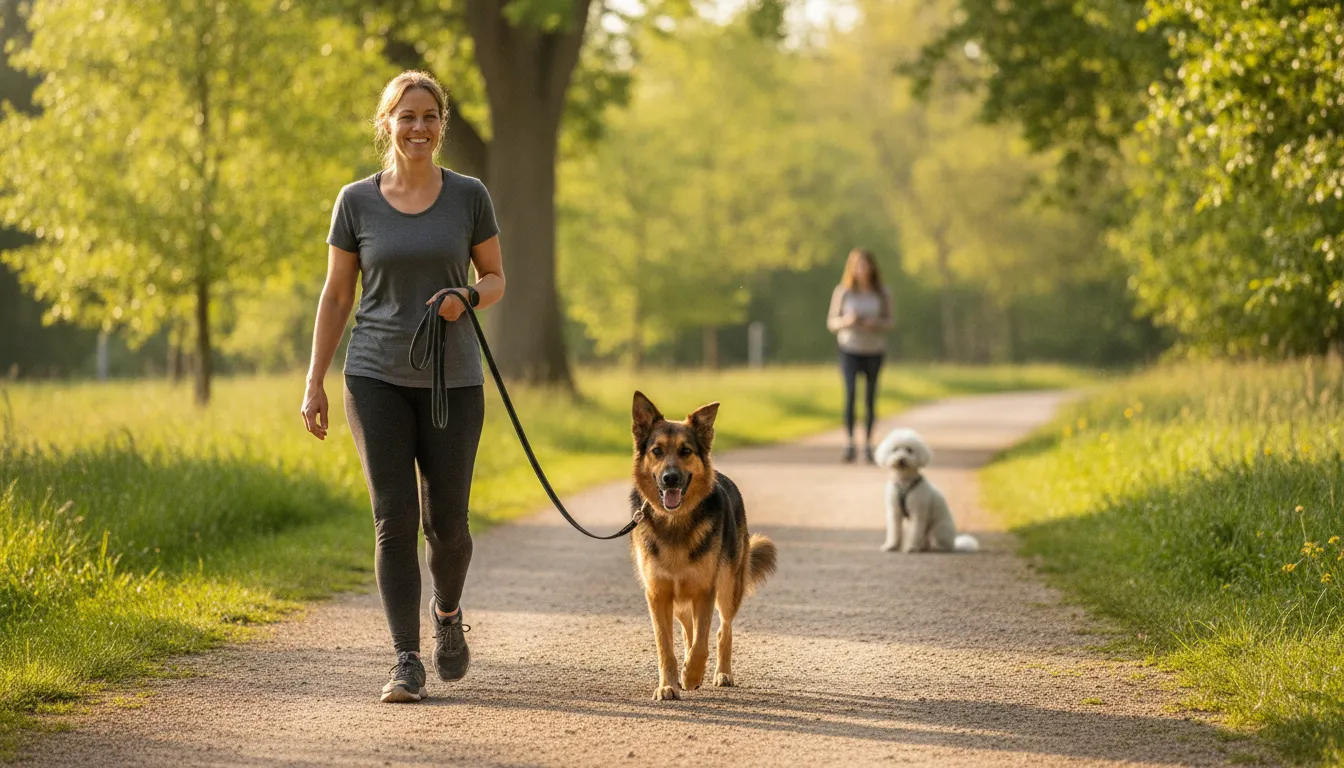
How to Stop Leash Aggression in Dogs Safely
Learning how to stop leash aggression in dogs starts with changing the training picture, not overpowering the dog. Work in small steps and treat safety as part of the lesson. If your dog is already lunging, do not add a new demand. Create space first.
- Identify the trigger. Record whether the reaction is aimed at dogs, people, bikes, vehicles, sounds, or a particular location. Note the direction and speed of the trigger.
- Find the working distance. Start far enough away that your dog can notice the trigger and still move, eat if food is part of your plan, or respond to their name. This distance is more useful than guessing how close your dog should be.
- Watch for early signals. Look for a fixed stare, stiffening, closed mouth, weight shift, or sudden loss of attention. These changes tell you to act before the bark or lunge.
- Create space without panic. Cross the street, step behind a visual barrier, turn down a driveway, or calmly change direction. Avoid jerking the leash or dragging your dog into a tighter space.
- Reconnect before asking for more. Once your dog can breathe, move, and look toward you, use a familiar turn or a few steps beside you. Give the dog time to organize their body and attention.
- Practice below threshold. Repeat brief exposures where your dog can succeed. End before the dog is exhausted or repeatedly reacting. A short successful session teaches more than a long walk full of rehearsed lunging.
The goal is not perfect stillness. The goal is a dog who can notice pressure, stay connected, and make a safer choice. If your dog reacts, gather information instead of treating the session as a failure. Increase distance, simplify the setting, and try again at a level your dog can handle.
How Can You Build Calm Leash Skills in Real Life?
A response that works in a quiet room may disappear on a busy sidewalk. Real-life progress comes from gradual generalization. Change one part of the picture at a time, such as location, distance, trigger movement, or duration. Keep the rest familiar while your dog learns.
Choose the environment strategically
Begin on a route with room to move and clear sight lines. Avoid narrow paths, crowded entrances, and places where several triggers can appear at once. The best training location is the place where you can see what is coming and give your dog enough space to think.
| Supports calm learning | Makes reactions more likely |
|---|---|
| Open space and planned exits. | Narrow path or blind corner. |
| Short practice with breaks. | One long walk full of barking. |
| One new distraction at a time. | Several new distractions at once. |
Build a repeatable communication pattern
Use the same early response each time. Notice the trigger, use a calm cue, turn, and walk to a safer distance. The pattern should be easy enough to use while managing the environment. Your dog learns that reconnecting with you changes what happens next.
Equipment should support communication and safe handling. The Sidekick is a training head collar and slip lead in one, designed to support calmer thinking and clearer guidance when used as part of a larger method. It is not a replacement for training. Review the Sidekick training leash when you want to understand how the tool fits into a relationship-based approach. For another household foundation, read the Heather's Heroes crate-training guide.

When Should You Seek Professional Behavior Help?
Home practice can build better communication, but it should never require you to gamble with safety. Contact a qualified behavior professional after a bite, injury, redirected bite, equipment escape, or behavior you cannot safely manage. Veterinary input is also important when behavior changes suddenly or may be connected to pain.
Get support after a bite or serious incident
After a bite, separate the dog from the situation, obtain appropriate medical care, and seek qualified behavior guidance. Do not recreate the incident to test what happens. Write down the context while it is fresh, including the trigger, distance, handling, location, and what happened immediately beforehand.
Escalate when the plan is not safe to manage
If you cannot hold your dog, create distance, or predict what happens next, stop practicing in public settings until you have support. A professional can help you build management steps that match your dog, equipment, household, and environment. You can also review this peer-reviewed canine behavior resource.
Choose help that protects the relationship
Look for guidance that takes emotion, body language, safety, and the human-dog relationship seriously. You should leave with clear management instructions, measurable practice steps, and an explanation of how to adjust the plan when your dog is struggling.
For the required cluster connection, return to our leash reactivity foundation guide as you build the next training skill.
Explore The Sidekick Transitional Leash
Frequently Asked Questions
How can I tell whether my dog is leash reactive or truly aggressive?
You cannot determine motivation from barking or lunging alone. Track body language, triggers, distance, recovery, bite history, and what happens when the dog has an opportunity to create space. Ask a qualified behavior professional for an assessment when the behavior is severe, unpredictable, or connected to injury.
What should I do when another dog appears on our walk?
Notice the dog early and create distance before your dog reacts. Cross the street, turn around, use a visual barrier, or move to an open area. Keep leash communication clear and help your dog reconnect once they can think. Do not force a greeting.
Can leash reactivity improve without harsh corrections?
Many dogs can improve when training addresses the emotion and gives them a clear alternative. Work below threshold, use natural guidance, build repeatable patterns, and adjust distance when your dog cannot respond. If the behavior is unsafe, use professional support rather than experimenting on a busy walk.
How long should a leash reactivity training session last?
There is no single session length for every dog. Start with brief practice while your dog can still learn. Several calm repetitions are better than continuing until the dog is overwhelmed. Adjust duration based on body language and recovery.
When should I contact a behavior professional?
Contact one after a bite, injury, escape, unpredictable behavior, or any situation you cannot safely manage. Veterinary input is appropriate for sudden changes or possible pain. A professional can help create a safety plan and training steps for your dog's needs.


